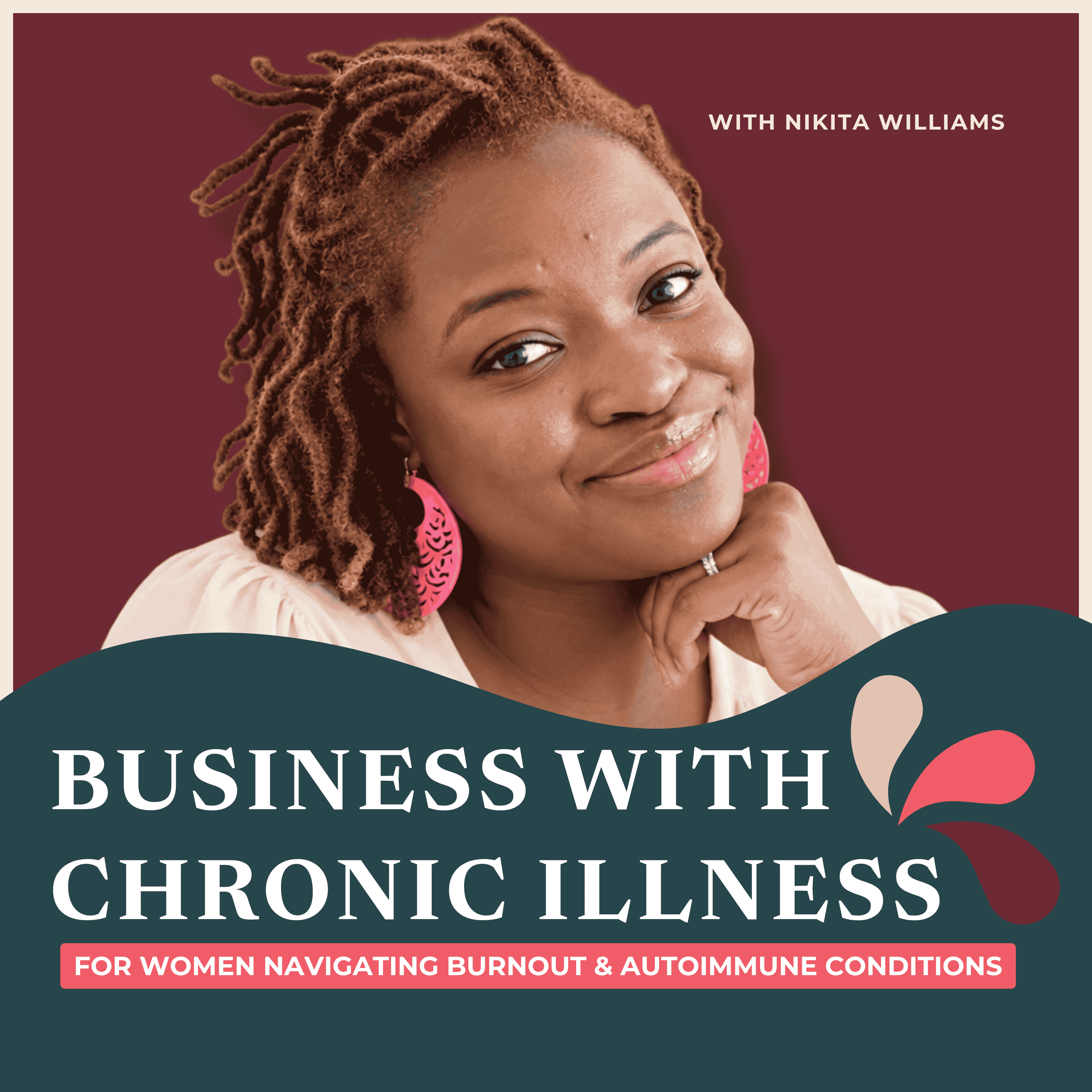
Do you wonder how you can effectively manage your autoimmune disease while also fulfilling your family responsibilities, growing a business, and maintaining your well-being through self-care and setting boundaries? This episode is tailored to answer just that. Join our guest, Jacquelyn Lovett, a Certified Holistic Nutritionist & Licensed Zumba Fitness Instructor who lives with Graves disease. We delve into the intricate balance of managing an autoimmune disease amid family responsibilities and the crucial practice of self-care while growing a business.
Here's what you'll take away:
Holistic Health Hacks: Integrate holistic nutrition and lifestyle changes into your daily routine with small shifts you can make to create a big impact on your health and energy levels.
Self-Care Simplified: Strategies that fit into your busy life. You'll learn the art of setting boundaries that protect your time and energy, making room for what truly matters to you and your family.
Building Resilience Amidst Family Life: Find strength in vulnerability and learn to navigate family dynamics with grace and resilience.
Share Your QA's or Thoughts and Join our Free Community Channel Here!
My mother in law, when she was here and we were taking care of her, she had so many health issues. And when she moved in, I tried to fix it. I was like, well, I'm a nutritionist. She was a diabetic. And I was like, I'm going to fix her all these healthy meals and do this, this and that, and she's going to get better. And guess what? She started getting better. But when we weren't looking, she had family members bring over good food that wasn't good for her, or they would come and pick her up and take her.
And my husband told me, he said, you can't control it. She's been doing this all her life. But I had to realize these people who we love so very much, we love them so very much, we can't control their life. It's their choice.
Nikita Williams
Welcome to Crafted to Thrive, the globally ranked podcast for entrepreneurs living with chronic illness. I'm your host, Nikita Williams, and after being diagnosed with multiple chronic illnesses myself, I figured out the surprisingly simple missing links to growing a profitable business without compromising my health. Since then, I've helped dozens of women just like you learn how to do the same. If you're ready to own your story and create a thriving business that aligns with your health and well being, you're in the right place. Together, we're shifting the narrative of what's possible for entrepreneurs with chronic illness.
This is Crafted to Thrive. I am so excited to have Jacqueline on the show. Me and her have been like, in each other's world for like a couple of years, it feels like now. And I'm excited for her to introduce herself so you guys get to know her a little bit.
Jacquelyn Lovett
All righty. Well, thank you so much. I'm happy to be a part of your world. I've enjoyed being the times that we've been able to interact, but my name is Jacqueline Lovett and I am a certified holistic nutritionist. I'm also a licensed Zumba dance fitness instructor as well as a natural hair health educator. And what I do is just work with women and helping them to transform their lives by means of self care, holistic nutrition, and Zumba dance fitness. And from time to time, we throw in a few natural hair care tips as well.
Nikita Williams
And that's such a good thing. That was one of the things I just recently learned about you, which was the natural hair, because I always see you on Instagram doing Zumba and, like, talking about food. So when I saw, like, some of our mutual friends traveling up to Georgia to Come get you. Do their locs. I was like, wait a minute. Wait a minute. Wait a minute. You mean. So it's really cool to hear about that. I can't wait to hear a little bit more about how that journey started, but tell us a little bit more about what led you to where you are today.
Jacquelyn Lovett
Okay. So for the hair side, I've been into hair care for 26 years now. Yeah. This year. 26 Years. I started out working in a salon 28 years ago as a shampoo assistant, and then it just progressed from there, and I ended up branching off on my own. But. But as far as the holistic nutrition aspect, I actually had some health issues that came up, and that caused me to want to look further into ways that food could heal our bodies. I know it's no 100% cure in this world that we live in right now, but just, I wanted to know.
I knew it had to be a better way because I was diagnosed with Graves disease, and that was five years ago. And so I knew it had to be another way other than piling on medication after medication. So that's what led me to where I'm at right now.
Nikita Williams
Yeah. So tell us a little bit more about Graves disease and what it is. I always think it's really important that we define some of these things that we experience, because so many of us have them or might have symptoms of them. And I think it's an important piece of the show to just allow people to be like, hey, that's maybe something I've never heard of before. I've heard of it before. I actually have a client that has Graves disease. So what does that. What is it?
And what does that look like for you? Because that looks different for everyone, right?
Jacquelyn Lovett
Yep, that is correct. So what it is, is it's an autoimmune form of hyperthyroidism. So for me, what it looks like was I just started getting really tired, started losing weight rapidly. Heart rate was just constant. It was up. I went into tachycardia several times throughout the day, and just feeling sick, I went into a depression. I couldn't work for about six months. I could not dance. Now, you know, that was hard for me, being a Zumba instructor. Right.
Nikita Williams
Yeah.
Jacquelyn Lovett
So, yeah, so at the time, I was a student, but I got to where I couldn't dance. I was just laying in the bed a lot. So not like me dealing with anxiety. But what happened was my thyroid started to attack my, like, entire body, My liver enzymes. It just really took a toll on me in so many different ways. So, yeah, it's something that doctors, they don't always look at your thyroid when you go in for a physical. They don't always do the blood work for it.
But I have a family history of it. My mother, my birth mother, who has passed away, she also had hypo and hyperthyroid. She was back and forth. Yeah, yeah. So they were like, it could possibly be genetic, but really, you know, it's just an unknown thing as to how people get the disease right now. But stress was one of the biggest factors that led to it for me.
Nikita Williams
Yep. That's not news to us. We hear that often. You know, a lot of the things especially I find for women of color, we present with these chronic illnesses, like, after really stressful times. We don't usually experience them. Like in the tornado, so to speak. It's like after the tornado's gone, the sky is blue and all these other things. You're like, wait a minute. Something not right. And, you know, we start dealing with these health situations. I always tell my husband, I'm like, we know how to, like, weather a storm without dealing with the storm, which is part of the reason why we ended up with chronic illness and stuff that we deal with.
But I would love to hear more about what has helped you in a nutritional way. How did you dive into that? Because were you doing that before you were diagnosed with Graves disease?
Jacquelyn Lovett
So what I was doing was I was always active. That was not a problem. I would eat healthy, but then I would fall off. Eat healthy, fall off. So I would do that a lot. But what has helped me when it came to the food aspect was I went to a holistic doctor. I had a really good friend. She was one of my best friends and still is. And she encouraged me to go and see her doctor because she knows that I have a family history.
My grandmother, who's 93 this year, still living, she was into finding ways to, you know, be able to cope and heal holistically. That's the word I'm looking for. She had a garden. We ate off the land. Like, we really did. It was a chicken running around in the backyard in the morning, and by the evening, we had chicken for dinner. I mean, like, that's how she was. And she lives right here in Georgia, you know, so her and my grandfather, that's just how it was. You know, they just.
They raised 11 children. So she had to find a way to make sure that we were eating, but at the same time, ate healthy. So all of that started coming Back to my mind. And then my friend said, check out. This doctor went to check him out. The first thing he said was, you have to let go of gluten. And then he started naming a list of foods. And I was just like, what in the world? How am I going to do that? But I knew I had to because.
And it took a while. One thing about when you do things the holistic way, as I'm pretty sure you know, it takes three to six months before you may even see results. And. But once I started seeing them, I just took off with it and then I ended up getting certified because I knew a lot about holistic living, but I wanted to be certified. So I did get certified within the last few years. And it has made a difference. Self care, you know, not just eating healthy, but I had to start saying no to things.
I'm a mother, I'm a grandmother, I'm a wife.
Nikita Williams
Wait.
Jacquelyn Lovett
A.
Nikita Williams
Minute, I'm not a grandmother.
Jacquelyn Lovett
Yes. Five and six year old grandbabies. And, and at the time we were helping to take care of them, we had. It was a situation where we, as the grandparents had to step in to raise them. So I had a lot going on. Yeah.
Nikita Williams
Wow.
Jacquelyn Lovett
Yeah, so.
Nikita Williams
Wow. That's a. Y'. All. I'm still. My head is like, my brain is still, you know, they say black, no crack, but for real, for real, like,.
Jacquelyn Lovett
Oh, thank you. It's.
Nikita Williams
Amazing. Yeah, I love it. I'm like, oh my goodness. I, I would never have guessed you were a grandma. But were you going through all of this change and like new? Not even like new, but more integrated, like lifestyle healing while, you know, taking care of all those responsibilities?
Jacquelyn Lovett
Yes, I was. I remember like dropping to the floor one day, like collapsing. I was still alert, but I was so weak because my thyroid was out of control. And we had little babies, you know, grandbabies to take care of. So yeah, I was going through all of that and I knew something had to change. And then fast forward two years ago, we had to care for my mother in law who has since passed away from dementia. So yeah, we thank you. We were her caregivers.
So all of that while dealing with a chronic illness, it has definitely been a challenge. It has multiple. And running a.
Nikita Williams
Business, a couple of businesses itself.
Jacquelyn Lovett
Yes. So I had to work on balance. I'm constantly working on balance and saying no to some things because I'm just not, I'm not. I know we always call ourselves superwoman, you know, but no, no, no, I couldn't do it anymore.
Nikita Williams
So let's talk a little bit about that, because I definitely think women in general are just like. I just think we do some really amazing things. I'm very thankful that we have been blessed with so many different capabilities. And I always think about how we were kind of intended to be these supporters, right? These pillars, these completers, right? And I wonder how has this, like living with chronic illness, living with all of the roles that you play, right? How is self care? Because you not only are living with chronic illness, but you're also being a caregiver to your family and your children and then grandchildren.
And as you were saying, like, trying to find balance or. I have a hard time with the word balance because I always feel like the scale will never actually be balanced. I think it's kind of more like finding that harmony between the yeses and the nos and then like the priority. So for. For you, what has that looked like? And what has been some key things that's been really important in your journey.
Jacquelyn Lovett
So some key things that have really been important to me. Taking a few minutes each day to count my blessings because it's free, so I don't have to spend money on it. All of.
Nikita Williams
It.
Jacquelyn Lovett
Like, you know, because sometimes it's been so many times over the years where I just did not have the money to do some of the things I wanted to do that we consider self care. I know self care is different for everyone, so I had to redefine self care for myself. It was like, okay, what free things can you do? So I garden. And when I'm out of my garden, and it's a small garden, when I go out there, I do not have my phone or.
Or anything with me unless I'm taking a few pictures. But I get away from my phone, my electronic devices at nighttime. I create a peaceful, serene environment in my bedroom. You know, diffuser, have my essential oils going, turn the TV off. My husband likes to have it on, but I'm like, just turn it off. You know, it's like he needs that background noise. So instead we're like, using our diffuser. But most importantly is setting boundaries. Because I am a yes woman, I used to be. And because I am a hairstylist as well as running my other business, love for health.
I found myself just. My schedule was all over the place, so I had to set boundaries. That is one of the biggest things. Saying no to people that I love so very much, but realizing that I'm not God and I cannot handle everything.
Nikita Williams
So.
Jacquelyn Lovett
That.
Nikita Williams
That is so that point I'M just like, the point about we are not. We are not. We are not as much as we. We want to be. I think part of it, too, is that we want to be all of the things to all of the people sometimes. And in. In the context of what we're talking about today from role shifting, I really do feel like it's lots of role shifting we have to do how. What has been some challenges and fears of practicing. No. Right.
Because it's not that we don't want to sometimes, but we care about these people. But what has been a challenge for you to get over or a mindset shift you've had to kind of, like, critique in order to get into a place of being okay with saying no or not right now, or you need to ask somebody else. Right.
Jacquelyn Lovett
Mm. So one of the biggest challenges was the fear of losing people that I love. The fear of me saying, I can't help you. And then they would just walk away or walk out of my life. And then I had to realize, if they love me, they'll stay. They'll stay, and I'll. I'll be there for them doing what I can. But just realizing I couldn't do it all, and I still can't. I have to tell my family, no now, friends, no, I'm sorry. I do what I can to my capacity, you know, whatever is within my capacity on that day.
So, yeah, just that fear of them leaving. But especially when I come to the business, I want to say especially with hair, because before I became where I'm at now with hair, I used to offer some other services, but I had to cut back. And I was like, man, I'm gonna lose everybody. But it's funny, because now they've all switched over to my new services. Yes. Wow. I didn't expect that. But, yeah, that's. That's a fear.
Nikita Williams
Yeah. I mean, especially in business. That's definitely a thing. I had the same thing with. With my podcast. Like, you know, I think we talked about this, actually, in one of the groups we're in together, and I was like. To find the more alignment, Right. It was like, it's easier, which makes it easier to say no. It makes it easier for me to do what I love. It makes it easier for me to make the income. Was like, I need to start teaching people how to do a podcast.
Basically. Like, this is what I've done, literally, from hysterectomy, hospital bed, literally. I've had a podcast. And it was the easiest thing in my mind, Right. To help Me grow my business. And it has. Right. It has done that. And I've been like, discounting it. But my fear, the discounting was more about, like, nobody wants to do that. Nobody. That's. They could just Google that. That's just a simple thing. And when I was, like, thinking about doing it, like, as a part of my coaching program, everybody was like, oh, yeah, I've been wanting to do that too.
And I'm like, the fear that I was like, tripping about, like, they're gonna leave, they're never gonna come. Like, they don't want to do this. They're all like, half of my clients are already. Yes. I'm starting a podcast. So it's so funny how sometimes we, like, these fears we have are the things that turned out to be kind of like a blessing in disguise. Like, if we didn't set that boundary. Right. Like, if we didn't set that boundary, we could be struggling for no reason.
Jacquelyn Lovett
Yeah. Yeah, I definitely agree. Yes.
Nikita Williams
Yeah. So, like, for you and your journey as far as, like, boundary setting, and by. Especially you were saying in your business, how about in your personal life of taking care of others? Right? Taking care of others, taking care of yourself, what particular tools have you been using specifically to take care of yourself to process? One of the things I've been thinking about and doing even more so because our family is going through some crazy changes right.
Jacquelyn Lovett
Now.
Nikita Williams
Is the processing in the moment as they're happening versus being like, I'm going to set them aside and deal with them later. It's almost like a rubber band stretch. I always feel like it's like a rubber band until you just pop and then it's. You have to deal with it. How have you or have you found a way when life is lifing, to process and self care in those moments?
Jacquelyn Lovett
Oh, that's heavy. Because I'm telling you, and I'm sorry your family is going through it right now. But when I tell you we have four, well, almost four adult children. We have three adult children, and the youngest one is 17, so the oldest one is almost 26. And he taught me how to be a better woman.
Nikita Williams
Wow.
Jacquelyn Lovett
Because as a parent, I had to realize that he had to make his own choices in life. All of our children, not just the oldest one, but they had to make their own choices in life. He was their adults. We can't run their life for them. So when we were going through some things, big, huge things, what I learned to do was say, I cannot control this anymore and I can only Control myself. And that has helped because I start taking that time because children grow up family members.
Even if we don't have children, our spouses, they're adults. They're going to do what they want to do, whether it be good or bad.
Nikita Williams
And.
Jacquelyn Lovett
I had to realize I only could control what Jackie does,.
Nikita Williams
And.
Jacquelyn Lovett
That's it. Or Jacqueline, as everyone else knows. Yeah. And that has helped me because now I. I step back and I pray for them, and I just hope that they are okay and they're safe and that they're making the right decisions for themselves. But, yeah, just have to learn to worry about myself. Worry about myself,.
Nikita Williams
Jacqueline. I think that's such a powerful thing. And I am 36. I have to remember that I'm 36 because I.
Jacquelyn Lovett
Turned.
Nikita Williams
36. My husband, I think, thank.
Jacquelyn Lovett
You.
Nikita Williams
My husband cracks me up. He's always like, nikita, you still think you like 26. And you keep saying you a younger number, but you are not anymore. Like, we need to catch up. But anyway, for something I'm learning, which is something I'm curious about for you, was there something that, like, triggered. Hey, I mean, I am taking on people's stuff like it is mine. I'm making decisions like. Like it is mine. Like, I think I'm having that realization this year, the last two years, really, of realizing snap.
I have been in a lot of different ways, especially in my personal relationships with people, not my clients, because I definitely don't do that with them, but with my. My people, like my. My close family, I find that. That I have now, someone brought it to my attention, was like, you know, you can't control what they do. And also you trying to live in controlling them means you're not living. And I was like, snap. And it was stated to me in the sense of, aren't you tired of, like, thinking about everybody and, like, curtailing?
And I never thought I was having that issue. I 100% felt like I'm living how I want to live. And then I realized when I started paying more attention and became more a part of my awareness, I was like, oh, my.
Jacquelyn Lovett
Oh,.
Nikita Williams
My goodness. Oh, my goodness. So for you, as you were saying, your son really taught you, was there a pivotal moment where it's like, I can't control your life or I can't be trying to control your life?
Jacquelyn Lovett
Yes, there was, girl. There was. It was when we would suggest things and he would do it, what he wanted to do anyway, and he's an adult, you know, like I said, not just him, our other children too. We have three adult children. We've suggested things to all of them, but they did what they wanted to do anyway. My mother in law, when she was here, we were taking care of her. She had so many health issues. And when she moved in, I tried to fix it.
I was like, well, I'm a nutritionist and she was a diabetic. And I was like, I'm going to fix her all these healthy meals and do this, this and that and she's going to get better. And guess what? She started getting better. But when we weren't looking, she had family members bring over the food that wasn't good for her or they would come and pick her up and take her. And my husband told me, he said, you can't control it. She's been doing this all her life, you know, I mean, all of her adult life.
And that hurt because she passed away and I was beating myself up like, what could I have done? You know, I'm about to start tapping anyway. What could I have done to so where she would still be here? But I had to realize these people who we love so very much, we love them so very much, we can't control their life. It's their choice. And that's when I said I knew I had to start taking care of myself. And Jill Scott has a song that says it's called Prettier, Prettier.
And in that song.
Nikita Williams
I have heard the song.
Jacquelyn Lovett
Okay, yeah. But in that song she says, I'm so much prettier when I let it go. And I found that about myself because I'm now I'm able to spend more time taking care of myself instead of trying to control what other adult people can do, make the decisions that they can make. I'm trying to control it and I can't. So hard. But I just, I feel much better now. Let's put it that way. I feel much better now that I've let it go.
Nikita Williams
We could spend hours unpacking all of that because it's such a challenge. Because we want the best for people and we want them to be happy, want them live long, want them. We can see the pain. I think that's my biggest challenge with when I'm like, if you make this other decision, I know the pain because I've seen it or I've lived it or I've been there. And I think it's so important to recognize that if that's the pain, they choose. They chose it, right? I didn't choose it.
I didn't choose it. I was trying to help you, and you don't want it, so I'm letting it go. But that is such a hard thing to do. And I think for me, tapping has been a huge way for me to, like, learn to let things go, because I can mentally say I've let that go, but energetically, in my body, I have. Right. And how has. And we. We are both in a tapping coaching program together. And how has tapping been such a crucial part of the letting go?
Right, because we could say let go all day long. Psychologically, we can say it.
Jacquelyn Lovett
Yeah.
Nikita Williams
But physically, I don't think our body does it until we give it permission to do so.
Jacquelyn Lovett
I feel like when I tap, I just feel like I'm in control of that moment. I really do. And like you said, we both can. I'm pretty sure we both can agree on that. I feel like, okay, I'm gaining control of this moment right here. It makes me live in that moment when I tap. Nothing else matters. It's right now, what you're going through. Get all the negative out, all those negative feelings you're feeling. Okay, now let's come back in with some positive affirmations, and we can get through this, you know?
So it has really helped me to get through, like, just amazing.
Nikita Williams
Yeah. Yeah. How has dancing been a part of this? Because I know dancing in itself because y', all, Jacqueline loves some Zumba. Okay? You see her on her. You see her dancing and moving her feet. She be for real. You look so at peace and joy when you're doing it. Like, I love watching you, like, on Instagram, when I've seen your Zumba classes, I'm like, she is just enjoying this so much.
Jacquelyn Lovett
Thank you so much. I tell you, dancing, it takes me to another place. It's the happy music. Oh, and don't let me be able to. A nice sunny day and my husband has cut the grass, and I can go out there without shoes on. Oh, my.
Nikita Williams
Goodness.
Jacquelyn Lovett
My neighbors ride by, and they're like my cheerleaders. I have recordings of them cheering me on. But dancing, that's another thing, just takes me to a happy place. Because this world is just full of so much negativity, but it's also a lot of good things that are available. And so I'm trying to really just pay more attention to those things. And dancing is one of them. I've been dancing since I was a little girl. You know, I bust out with the MC Hammer, and, oh, boy, bring back some memories here.
But, yeah, dancing really is just. It really elevates the mood. Whether I'm going fast or slow, it just really elevates my mood.
Nikita Williams
So you've been dancing since you was a baby?
Jacquelyn Lovett
Yeah, dancing and running. I used to run too, in school. My sister and I were talking about that just the other day, how I used to run the relay races and things like that. And so I run too. I still do races now. Yeah.
Nikita Williams
Wow. Wow.
Jacquelyn Lovett
Yeah.
Nikita Williams
That is so good to hear. I think I like to say, everyone who's like, listening and saying, man, I wish I could dance, I wish I could run. Because it's maybe too painful or it's too much. You know, I think about, there have been times in my journey where it's like, somebody, I'm like, you want me to. What,.
Jacquelyn Lovett
You.
Nikita Williams
Think I can? What? Like, and I love dancing and I love, like, I just love being around people and just who are happy. And dancing is always that, right? Like, it's always that experience. You can't. Especially if you put some Caribbean music on. You.
Jacquelyn Lovett
Can't.
Nikita Williams
Like, my body literally cannot not move. My husband always jokes around like, you'd be at a party, you'd be sitting there like, nah, you don't do nothing. You could be swollen everything. Nikita. And then you'd be talking about some Bob Marley. Come on. You'd be like, oh, oh. It's just what happens. My body cannot not move. So for those of us who are like, in that place, the place of this is hard. Maybe they're in the beginning of this journey or maybe they have all of those different roles that you were talking about, their mom or their daughter and a wife, and they're taking care of this, or they're just going through a new diagnosis of graves disease or any other health challenges.
And they know that movement is good. They know that, that living more holistically is good. What are some baby steps? I always love to ask about the baby steps that they can take. From the mindset to physicality of what they can do.
Jacquelyn Lovett
All right, I love this. So baby steps when it comes to the nutrition aspect, add a plant to every meal. You know, so if you're eating Oreos, add you apple or a banana to that meal. When I, when I coach clients, I make sure to not tell them what they cannot eat. I encourage them to add healthy things. And the more they add in the healthy things, the healthy anti inflammatory foods, the less they crave the other foods.
Nikita Williams
But,.
Jacquelyn Lovett
Yeah, add a plant to every meal. When it comes to the movement in my classes, when I start out teaching each Zumba class. I let them know that if you're not able to move, get out of your chair, you can do it from your chair. Your focus is to move your arms. You may not be able to go as fast. You know, make sure your bottom is still. Don't, don't move your bottom too much. Because some people have different illnesses where they can't, you know, flexibility isn't good enough for them to move around.
So, yeah, I just encourage move your hands or just your shoulders. If you just want to move your shoulders, that's fine. So that's the fitness and the self care part. Takes five minutes a day to do something for yourself. Just five minutes. And one of those things that I like to do takes me longer than five minutes. I eat breakfast in silence. No tv, no phone, I don't even read during that time. Sometimes I may open the door so that I can look out. You know, sometimes I may sit on my porch, but I do it in silence.
So those are my three different areas that, you know, I encourage you to take baby steps in.
Nikita Williams
Oh, I love that. I'm curious more about the last step that you.
Jacquelyn Lovett
Said.
Nikita Williams
About eating alone. How did you come to that and how has that been self care for you?
Jacquelyn Lovett
I actually started that when my children were very small. I would get up before them and it just gave me time to think, you know, and to think about the positive in the day. Because my mind, because of childhood trauma, I could tend to go negative and dark so quick. So it just gave me a chance to just think, think about this delicious food that I'm blessed to have in front of me. No matter what meal it is, at least I have something to eat. Some people are out there starving or they're, they're wanting to eat what I'm eating.
So just being thankful for whatever it may be. My favorite meal right now is the oatmeal, of course. But just. But I needed those moments because we homeschooled our children. So all those years of homeschooling, it was like, you gotta have some time to yourself. You have to have quiet time. And then I stopped it for a while. And then recently I had to start back. And I can see the difference. Yeah, yeah. And they call it. I think they call it intuitive eating. Yeah, yeah.
Where you're just focused on that meal.
Nikita Williams
Wow. I'm not quite. I'm like your husband. I'm. I'm a person. Like, I need some music. I need some kind of something in the background to literally feel like, like I can hear My thoughts, because I think a lot.
Jacquelyn Lovett
And.
Nikita Williams
There's so many thoughts happening and I find when I am by myself, all those thoughts like start to collide, if you will. And for me, if I have some kind of music in the background or something, it helps me to like focus my thoughts. It's such an interesting how all of our brains are also different and that's part of the reason why I love having the show. Because everyone's way of doing self care is going to look different. Living with chronic illness is going to look different.
And I also just love that tip you gave about adding something versus taking away. Because most people I asked will always say, well, you need to stop eating this thing. And it's like, okay, well you've already taken something away that I love.
Jacquelyn Lovett
Right?
Nikita Williams
So I love that you're like actually just add, add a plant. And that's such a great point to do. I'm gonna actually start doing more of that because I need to start myself.
Jacquelyn Lovett
You got it. So thank you.
Nikita Williams
Let me know, like, tell me a little bit about what, what are some people or women in your life that inspire you?
Jacquelyn Lovett
Oh, well, I mentioned my grandmother, but I also have my aunts. I have my second mom. She's not my birth mom, but she and my dad got married when I was very young, but I got friends. You are one of the women that inspire me. I mean, because I've been looking at your. Like you say, we've been connected for a few years now, but I remember doing your course. I still have your course that inspired me. So you know, women who live with chronic illness and who are not afraid to say I need help, you know, we can't always show up on social media.
Just always, just so perfect and put together. No, that's not me. If you all get into my stories, you will see me standing in my kitchen, no makeup, hair, doing whatever and I'm just standing there talking. So women who live with chronic illnesses and who are continuing to fight for it, but lately, as of lately, and I know I, I just name a broad. That was a lot.
Nikita Williams
We all love a lot of, like a lot of women do inspire us, thankfully.
Jacquelyn Lovett
Right?
Nikita Williams
It's, it's.
Jacquelyn Lovett
A good.
Nikita Williams
Thing.
Jacquelyn Lovett
But as of recently, my two daughters, my 24 year old daughter and then my 17 year old, they inspire me. They really do. Because on days where I just like, they just, they take care of me and it feels good and it says a lot to me as a mother. Like they, they tell me, you took care of us and that really Means a lot. But they inspire me because I see them take care of themselves. They work hard, you know, take care of my oldest daughter.
She's married, she's taking care of her household. Just. They really just inspire me the way that they take care of themselves. I mean, they are just true little divas, you know, and they work hard for it,.
Nikita Williams
Love it. Well, they. You raised some beautiful girls then, and they are inspired.
Jacquelyn Lovett
By.
Nikita Williams
You. No doubt. No doubt they are inspired by you. So I love that you share that. I would love to hear what's coming up for you and your. And your business and some exciting things. Anything you would like to share that people can check out.
Jacquelyn Lovett
Okay. Yes. So, well, right now I already, I have two programs now. So I used to focus on one, but now I have two programs, one where you can work. We work together for a month just working on basic nutrition. But then I have my, my holistic wellness and nutrition program. That's a three month program and we go really deep. But what I have coming up, new things. I have Zumba for Spoonies. So that will be coming up in July. Yes. So my Spoonie community, a lot of us, we're not trying to be up early in the morning.
Nikita Williams
Okay.
Jacquelyn Lovett
So this will not be an early morning class. No, 7:15am Here.
Nikita Williams
I am.
Jacquelyn Lovett
One.
Nikita Williams
Of those spoonies who'd be like, you want me come early? What? Girl, I'm sorry. I'll see you at 11.
Jacquelyn Lovett
Yep, yep. And that's what I'm thinking of. It'll either be midday or it'll be more towards the evening. But yes, that, that will be coming in July as well as I'll be doing a few in person pop ups coming up. Yeah, down here. So, yeah, a lot of, you know, fun things to keep us all going. And one thing I encourage is that we just move at our own pace, you know, moving on. Don't compare ourselves to others. And that's what. That's Zumba for Spoonies. That's what that class will be about.
Moving at your own.
Nikita Williams
Oh, I love that. That's so exciting. I can't wait. Let me know when you have that. And I'll.
Jacquelyn Lovett
Be sure.
Nikita Williams
To promote that to all of my communities and, you know, all that jazz. We'll have a show, a link, link to it in the show notes when you get it out there. I think that'll be great.
Jacquelyn Lovett
Thank you. Well,.
Nikita Williams
Thank you so much for being on and sharing your story and your tips. So many good ones in here, y'. All. So thank you, Jacqueline.
Jacquelyn Lovett
Thank you. So much. I have thoroughly enjoyed and thank you for reaching out to me to be on the show.
Nikita Williams
Yeah. You know what it is, is, like, I'm around so many amazing women. Like, I feel like. And I'm like, I'm always talking to you all. And then I realized, oh, my gosh, I have not invited you. And I'm like, I need to invite you on the podcast because I'm getting all of your awesomeness. And I'm like, I need to share it. And so I'm so thankful that you were able to come on the show and just share. And I just think you're a light. When I first started on my journey as an entrepreneur online, I did not see a lot of me, like, a lot of women of color at any age group talking about health, talking about living with chronic illness, talking about hair or nutrition.
Like, I wasn't seeing that. And so now that it's been since 2017, 2016, I started, I see, like, more and more and more of these amazing women that I'm just like. And now I'm in their spaces. Right? And we're in each other's space. And I'm just, like, so excited about that because for a while I felt like, look, Nikita can't just be doing this all by herself. I know there's some other people out here trying to do this. I know there is. And I'm so thankful that we have stumbled into each other's world.
So thank you for. For being here.
Jacquelyn Lovett
Thank you. Yes. I was gonna say when you mentioned that you were one of my first podcasters as well, who was also on Instagram, I think, or maybe in Facebook. But anyway, yeah, I was like, oh, my goodness. Who? You mentioned we look alike and going through different things. I was just amazed. So that's why I was constantly on your page. And I still am, by the way. You know that so.
Nikita Williams
Well. Thank you again. And you guys definitely stay tuned and listen to. Check out the show notes for all of the details. That's a wrap, y'. All. Thanks for tuning in to Crafted to Thrive, the podcast that helps entrepreneurs with chronic illness to thrive and build a holistic business and life. Check out our website@CraftedToThrive.com for this episode, show notes and all the gifts and goodies. Connect with me on Instagram at Thrive with Nikita for more tips and behind the scenes and more. Tag me to share what you loved about this episode, and I'll feature you on an upcoming episode.
So until next time. Time, remember, yes, you are Crafted to Thrive.
About the host
Nikita Williams
Nikita Williams is a business strategist and coach for women entrepreneurs living with chronic illness. Through Crafted to Thrive and The Rooted Business™ framework, she helps founders build capacity-honest businesses that work with their bodies instead of against them.